Reimagining Fediverse Advocacy
Tackling the biggest problem of network effects: bringing people here.


I've long been an advocate for the Fediverse, or at the very least, some manifestation of a decentralized Social Web that anyone can take part in. As a whole, it is a revolutionary alternative vision to the concept of corporate social media. I wholeheartedly believe that an effort like this could change the Web.
Here's the rub: we're still not very good at advocating why people should join, or helping facilitate groups of people in their migration over here. The Fediverse, sadly, has something of a Linux problem. Fediverse advocacy often resembles Linux User advocacy, and aside from attracting some enthusiasts, doesn't often work well. Here are a few examples of what that looks like:
- "You should ditch Windows and switch to Linux, it's better and respects you as a user!"
- "Linux can do anything that Windows or MacOS can!"
- "It's so easy to use, you should totally try it!"
Cards on the table: I've been a desktop Linux user for almost 20 years at this point. I, too, have been this kind of advocate in the past, going as far as to start a petition to get Blizzard's games ported to Linux. Whether you're advocating to a person or a company, this method of outreach and advocacy just doesn't work.
Why doesn't this work?
For anyone with even a rudimentary understanding of marketing, it's pretty obvious that these kind of efforts are missing something. I can break it down into three points:
- Messaging: Generic feel-good messages about why someone should use product X instead of product Y don't generally have much of an impact. You can promise the moon and highlight flashy features, but these don't actually get people to think about why they ought to use the proposed alternative.
- Value Proposition: When it comes to offering a product to someone, it's important to understand what points are being made about the product, and what points of interest align with the person. With the Fediverse, one of our biggest mistakes has been to focus on open source, decentralization, digital sovereignty, privacy-respecting, and other similar terms. This is great for attracting nerds, but for the general population, it's useless.
- Onboarding: A lot of people will tell you to switch to something by pointing you towards an app to download, an ISO to burn, or a project page with a link to sign up somewhere. In a lot of cases, that's the extent of the help you get! You made the first move, now you're on your own. That is, unless you have an additional person with expertise to help you.
What Should We Do Instead?
In a practical sense, advocacy takes shape in many different ways, not just in the grassroots method I described. I want to break down a few principles, and follow up with some case studies where I think some promising work is happening today.
More specific messaging is better
We've established that broad-brush messaging is generally not that effective in getting new people to check out the network. You know what does work remarkably well, though? Figuring out specific groups of people that would benefit.
I'm not going to get super into the weeds here and say something corporate like "We need to design user stories that cater specifically to a bunch of demographics we've just imagined." Instead, I think we can look at the landscape of social media, and figure out a bunch of different groups of people that currently aren't having a great time on centralized social media.
A few examples
- Journalists, writers, and bloggers often find themselves struggling to stand out in an algorithmic timeline. Often, these timelines shut out smaller voices, and promote bigger ones that have a budget for promotion.
- Activist groups want to find spaces to collaborate together on their shared causes, without feeling like they have to look over their shoulder to check if big corporate social media is spying on them.
- Video makers want to find communities of people who are interested in watching what they have to put out into the world, without having to do A/B Testing or weird thumbnails of facial reactions.
- Families with Discord group chats are currently feeling weird about Discord's impending ID Verification System. They just want to have a space to talk with one another throughout the day, on the subjects they care about most.
Describe the problem and solution without jargon
Building on the last concept: we need to find a way to explain the value proposition of the Fediverse without using complicated words. The solution is a good one, but the value proposition is not the technology itself. It's what the technology does that counts.
Here's a typical technical description of what the Fediverse is:
The Fediverse is a collaborative network powered by thousands of servers running many different kinds of applications that all talk to each other using a common protocol.
While it's not wrong, you might as well be describing newsgroups. But, what if we reframed it to a more human-centric approach?
The Fediverse is a vision for the Web that takes away the hard barriers between websites and lets people communicate across them as if they were in the same place.
That's a lot better...at least, it gives me some warm, fuzzy feelings. But I think we can do even better than that, by re-framing the current state of social media.
What once started as social communication hubs for the entire world has degraded into a cesspool of advertisements, tracking, and censorship. Companies have determined how to hijack your most valuable asset - your attention - and used it to keep you logged in and active on their sites and apps. But the Web doesn't have to be this way. Instead, we can use the Internet itself to do everything we need, and connect without a giant corporate middleman. The secret? We can use the World Wide Web as our social network. We don't even have to be on the same website for it to happen.
Probably a bit too wordy, but you get the gist. Focus on a problem, talk about some user frustrations or concerns, and then explain why the Fediverse could be a viable solution. Avoid buzzwords, and focus on the mental picture of a corporate silo vs a federated network, and what the second option offers people. The best part is this: there are myriads of complaints about mainstream social media platforms. You can create different messages for different people by tapping into other points of contention.
Hold the user's hand gently
This is where we stumble the most. We kind of assume that pointing someone to a project page like JoinMastodon.org will somehow provide people enough of what they need to jump in and get started. The thing is, onboarding is the most crucial part of user conversion, and it's not a great situation in the Fediverse.
Here's some of the most common things new people ask when they join Mastodon:
- Which instance should I join?
- How do I find people to follow?
- How do I connect with my friends?
- Why won't this instance let me talk to my friend on this other instance?
- Why is this post in my home timeline?
- How do I look up a remote post to comment on it?
- Does blocking someone prevent them from seeing my public posts?
- How do I secure my account so just my friends see me?
- What app should I use?
And it goes on and on and on. Somewhere throughout this long line of questioning, a person might get exasperated and give up. It's a lot to comprehend right out the gate, and it takes a while to fine-tune your social experience to become comfortable.
Idea #1 - Data Import and Contact Sync
One thought that I've had over a number of years is that it's kind of a chore to move all of your stuff over from one network to the next. Facebook and Google at least have the courtesy to provide you with some kind of data archive of your entire social graph, but I rarely see any other systems make use of it. On top of that, it's really hard to find your friends in a new place.
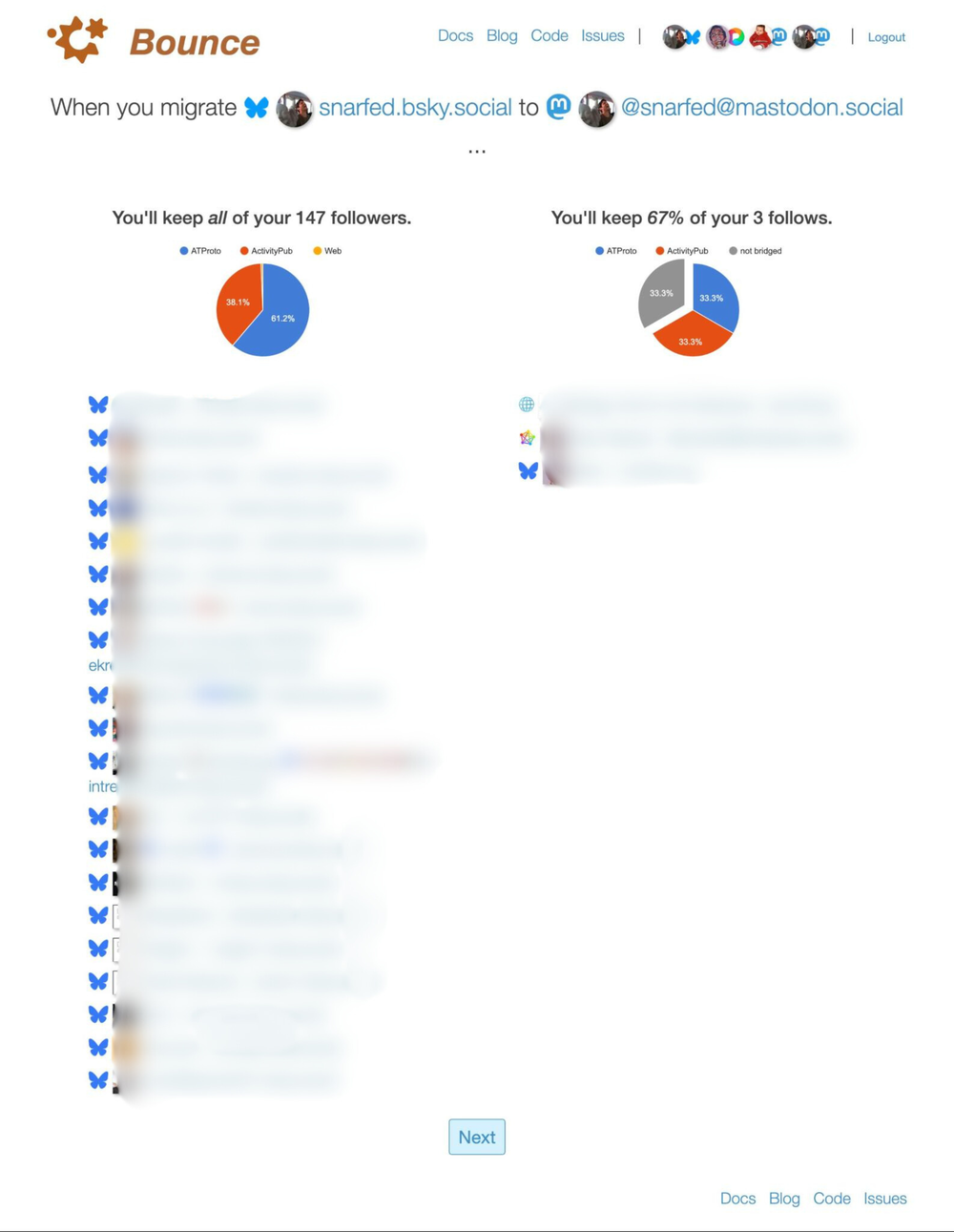
Not too long ago, I was inspired by Bounce, which gives people a way to move from Bluesky to the Fediverse and vice versa. It's a great tool and does some really clever things in the backend to make sure you stay connected with your friends on the other network. This lead to me thinking...why don't we do something like this for Facebook, and every other network?
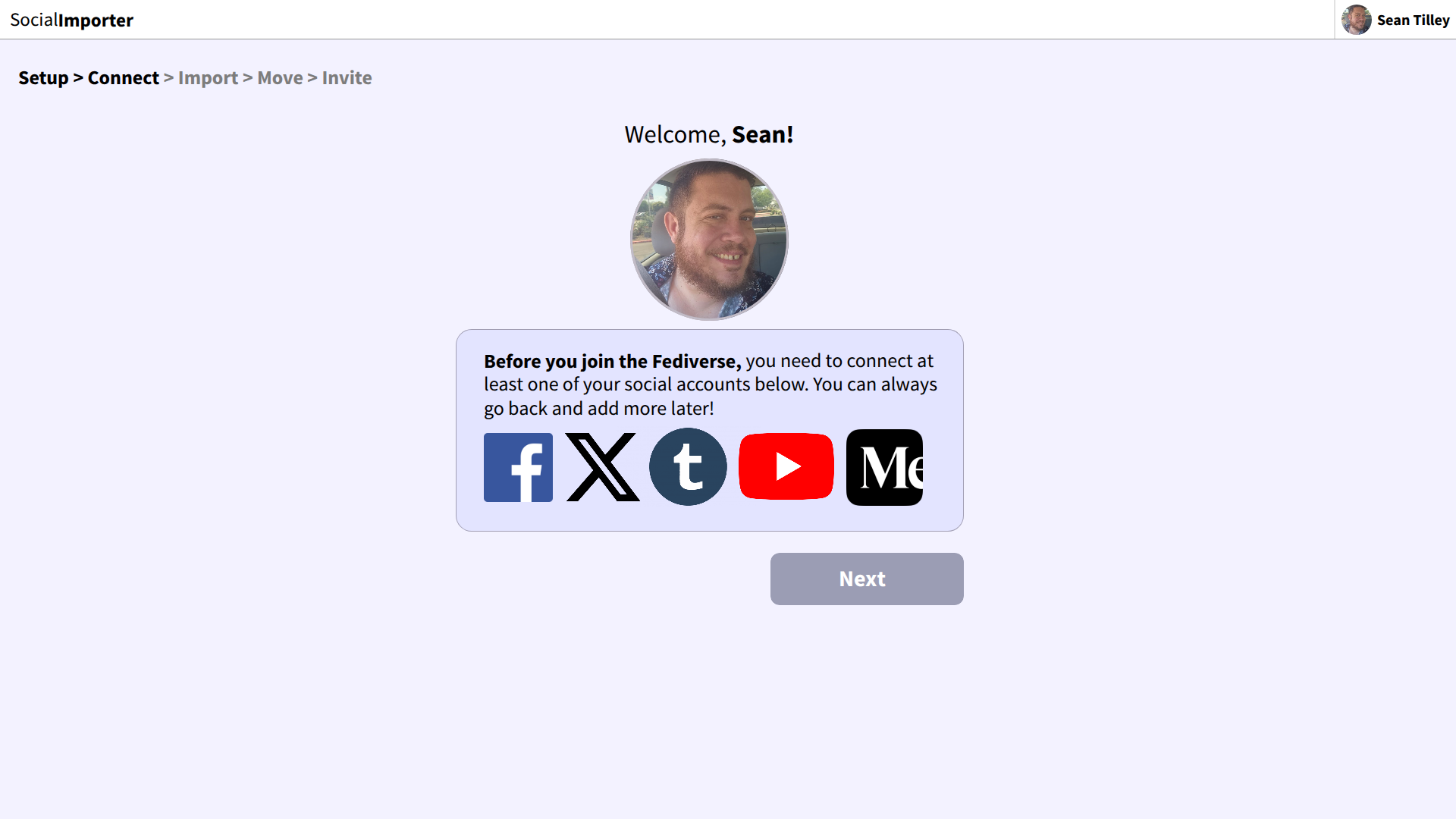
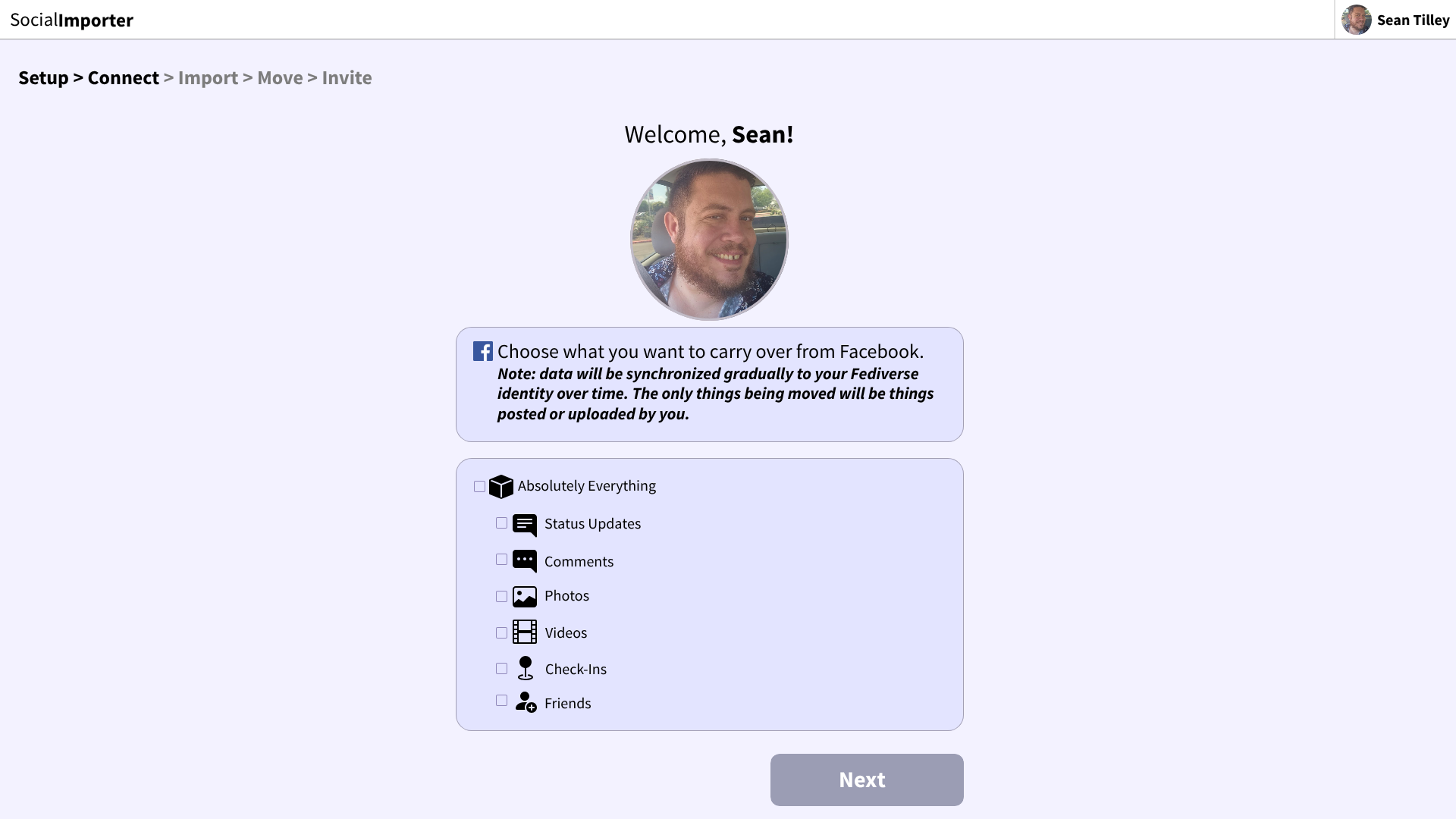
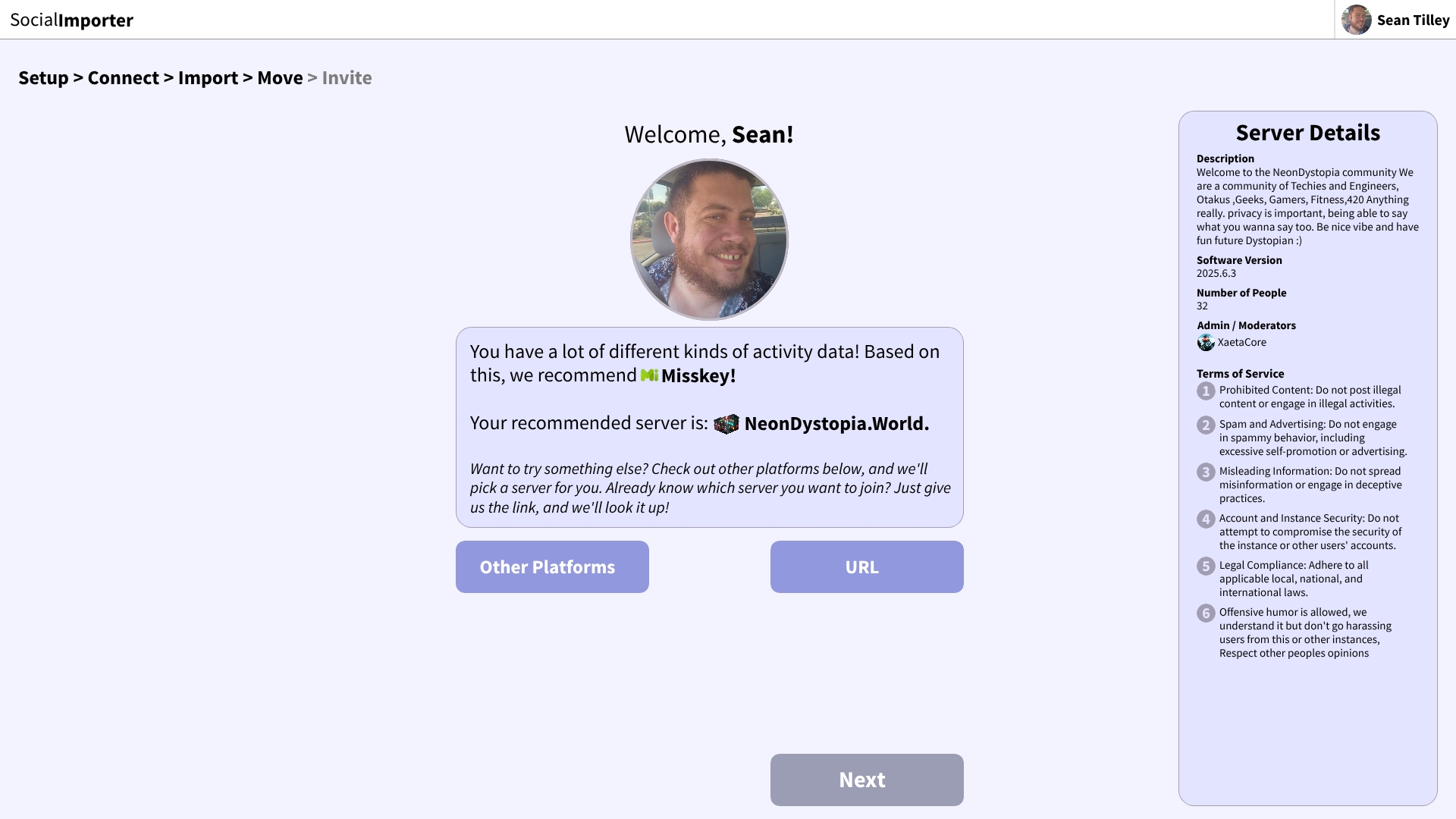
We could create a tool that's an essential part of user onboarding: offer a continuous sync of contacts, posts, and interactions. Do you have interactions from Facebook that don't exist on the Fediverse yet? No worries, we can backfill those later, and reconstruct the conversations in your old social graph. We'll even tell you about your friends who have already moved over.
Granted, not everyone is going to want to import their entire social archive over. However, being able to easily find your friends, or parallel accounts to Facebook pages you follow, would go a long way towards aiding discovery.
Idea #2 - Professional Hand-holding
Another way to tackle this problem would be to look at two very different places: at an organizational level, and at the individual level. This would require us to actually find people who are interested in alternatives to begin with.
For organizations, we could offer trainings and support to help teams get moved on to a new platform, with clear-cut instructions on how to do things. In addition, we could help social media teams get set up with Fediverse-compatible tools. Did you know that Buffer can post to Mastodon? Or that teams can self-host an open alternative like Mixpost to manage their operations? Some organizations might even go as far as wanting to launch their own social instances. Or maybe they just like the idea of having a blog that federates.
For individuals, we can do one better. Imagine if PeerTube or Loops had a strategy in place to reach out to prolific creators on YouTube or Tiktok, and were able to help those people get set up, import their media, and direct their existing followers towards these new platforms? Better yet, suppose we consulted these people on what they need out of a platform specifically? A fair amount of creators want their accounts to be set up for their own production teams. They want to focus on making videos and getting them out there to an interested community, and they want to direct people to donation links to help grow their channels.
Case Studies
I wanted to take a minute to focus on a few really interesting developments that I think play into what I'm describing. I'll try to keep it short and sweet.
Newsmast Foundation – Creating Community Apps
The first thing I really want to focus on is Newsmast, because I think they're solving a hard problem in a unique way. The organization has been developing special "white-label" Fediverse apps intended for specific community instances, such as toot.wales.
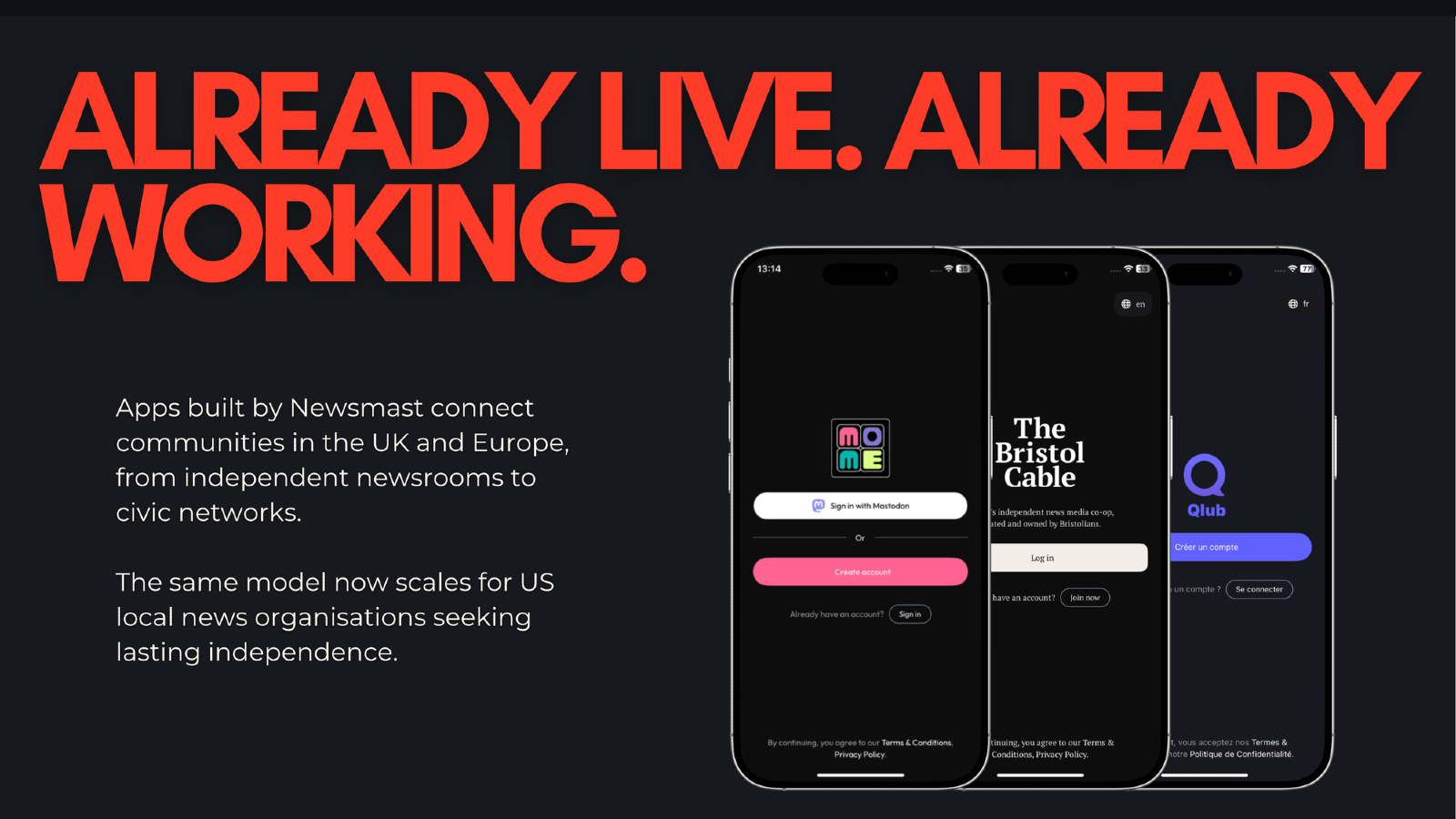
By putting on a custom face and releasing it to app stores, Newsmast is solving a very specific discovery problem. Instead of saying "Connect with us on Mastodon", and making users join a new network and do that onboarding dance, they instead just reduce everything down to downloading an app and signing up. You're still joining the Fediverse, federation still works as advertised. You just get a sleek branded package.
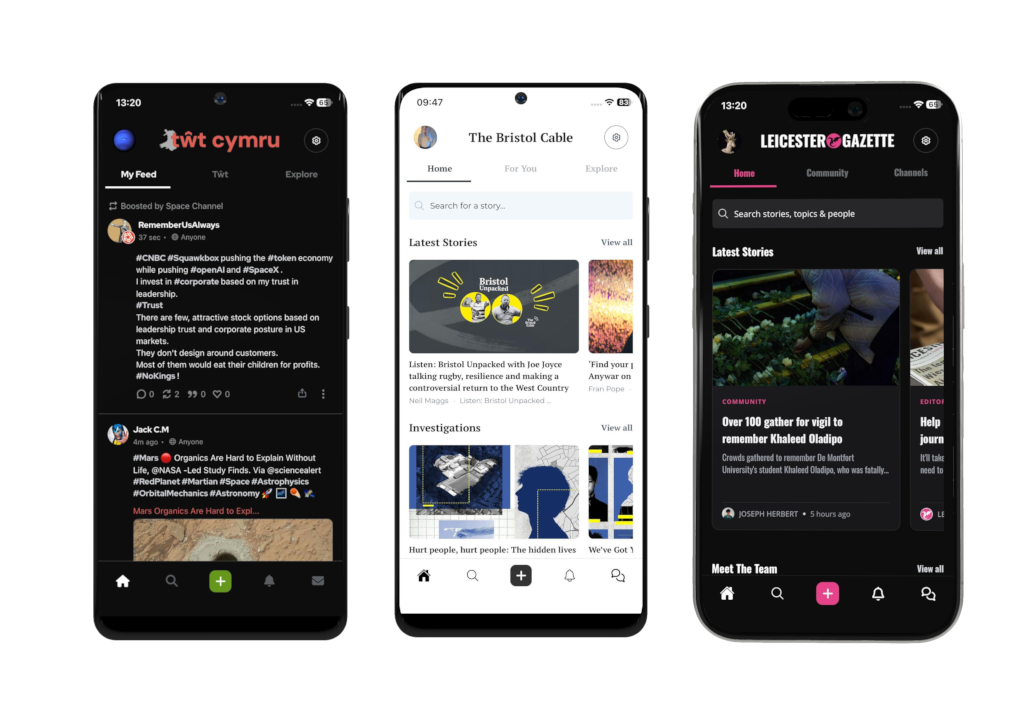
What's really crazy is that some of their integrations go way past just setting up a Mastodon server. Some of their apps actually integrate right into the provider's website itself, thanks to a little bit of magic with ActivityPub integrations and custom feeds.
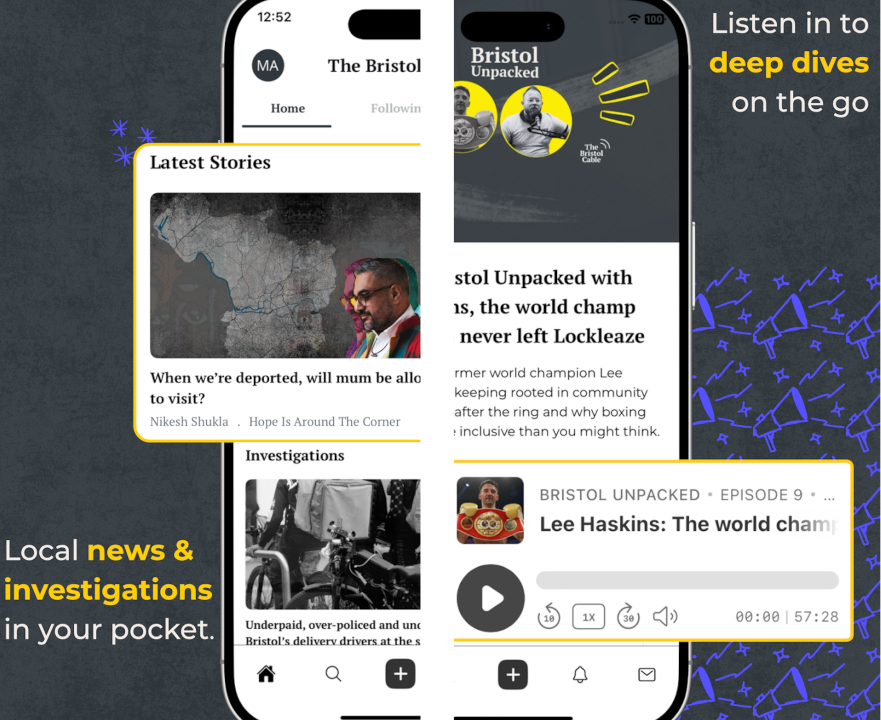
Newsmast is currently looking to expand beyond just Mastodon, and I think their partnership with Bonfire is going to be a big deal. Bonfire's whole thing is to be extremely extensible, and easy to customize. Maybe in the near future, these apps will support activities like Events, Groups, and more? For intentional communities, this could be huge.
A New Social – Bounce Migration Tool
A New Social is the nonprofit organization behind Bridgy Fed. Bounce is their newer migration tool, and it builds on top of Bridgy Fed to make it easy for people to move from Bluesky to Mastodon and vice versa.

While this might sound trivial on the surface, it's actually a really cool demonstration of how people can move their identities across different open federation protocols. There's a possibility for other protocols to gain support (both to Bridgy Fed and Bounce) in the future, but for now, they're working on making a robust product that's easy to use.
Hard Fork / Search Engine - The Forkiverse

A collaborative effort by two podcasts, Hard Fork and Search Engine, led to the launch of a new Mastodon instance called The Forkiverse, for fans and friends of both shows. Casey Newton, Kevin Roose, and PJ Vogt worked together to make this thing a reality, and have an active community that's part of the network. They told their audience about it, on a special episode.


What's crazy about this effort is that neither show is a small deal, when it comes to podcasts. Hard Fork is part of the New York Times, and Search Engine is said to be downloaded over a million times per month. These guys saw the Fediverse, liked what it was about, leapt in with both feet, and started a community.
Bonfire - Open Science
The Bonfire project is a bold, ambitious effort to build a highly-customizable Fediverse platform that can do it all. One of their main pilot programs has focused on creating a space for scientists, which has a number of specialized needs.
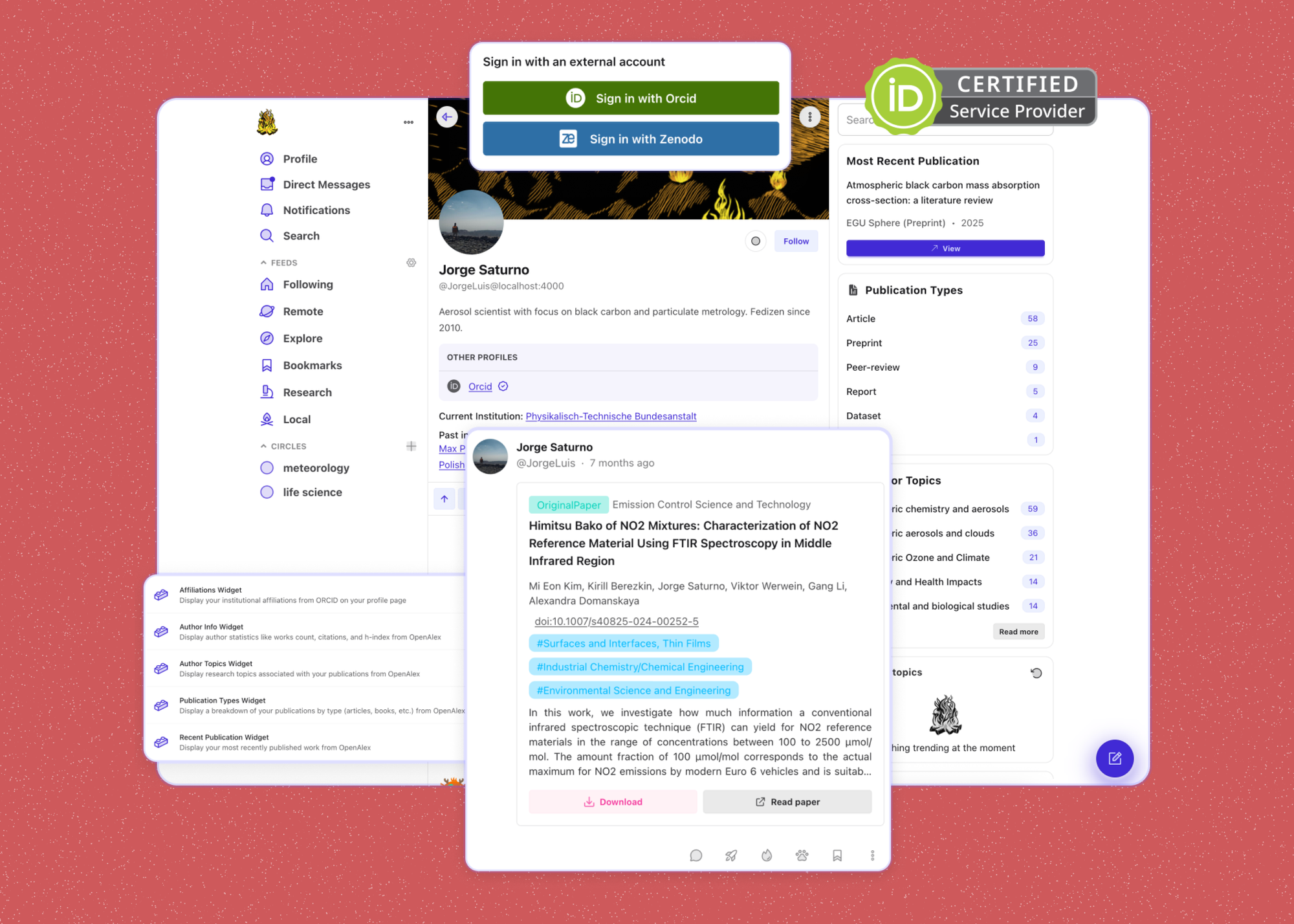
After consulting with members of the pilot program, the Bonfire team launched a dedicated instance with a number of special features. For example: researchers can log in with their ORCID identity, and automatically import their publications, which gets appended to a special section of their profiles. Published works can be easily previewed and accessed directly from within Bonfire.
AltStore - Federated App Store
Although it's currently only available in the EU, AltStore is an alternative App Store where developers self-host their own apps on dedicated servers. In a sense, the app store itself allows users to add sources from developers, and get represented as ActivityPub actors.
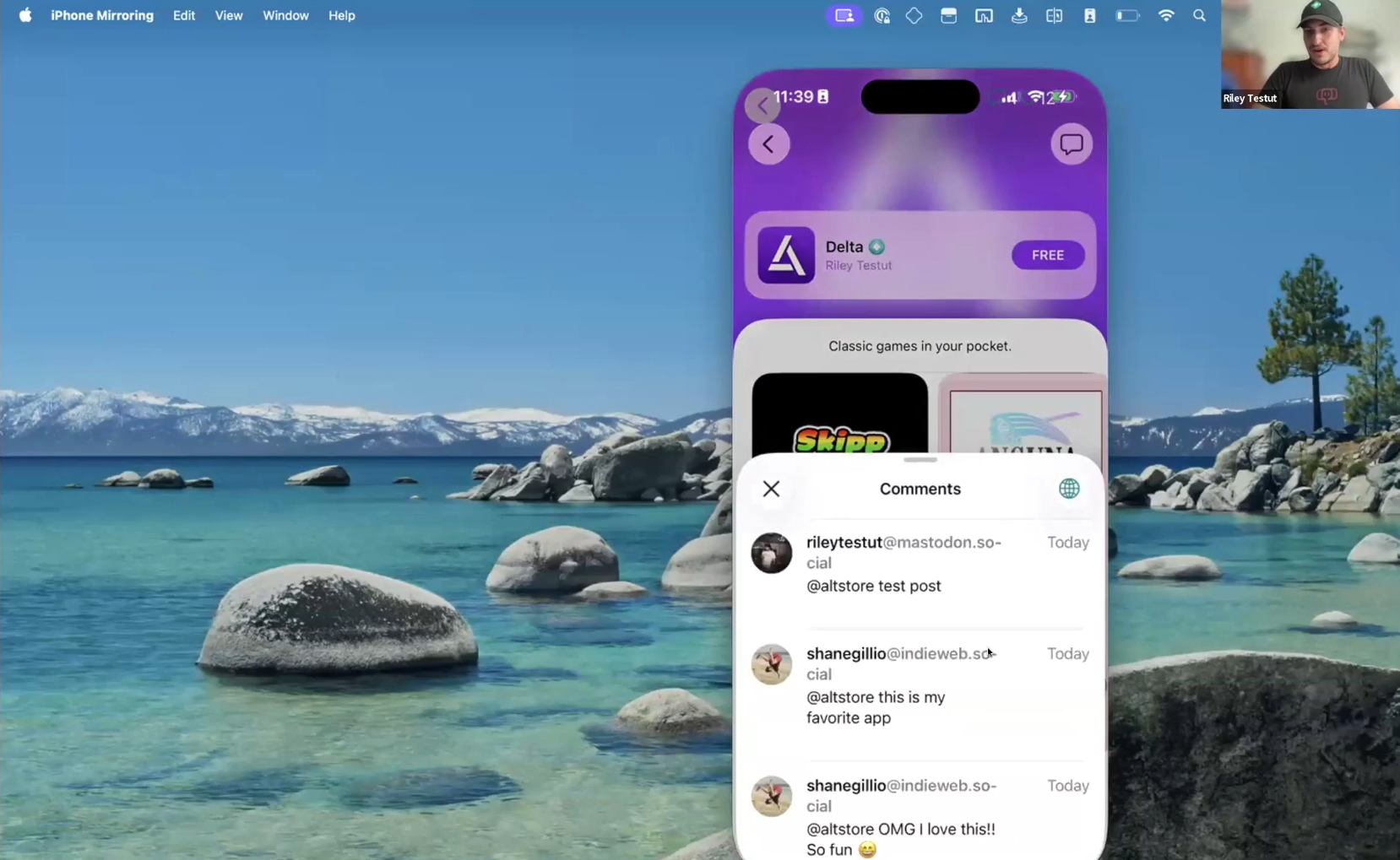
What's really unique about this approach is that interactions on apps and updates can be seen by the wider Fediverse, and viewed inside of the AltStore app. While it remains to be seen as to what kind of impact AltStore might have in the future, this is a clear signal to developers that they can take part in the wider Fediverse ecosystem with very little effort.
TilVids – Bringing Creators to PeerTube
TilVids is kind of a big fish in a small pond. They have a number of YouTube creators mirroring their stuff directly onto PeerTube, with some of them even making exclusive videos just for the network.
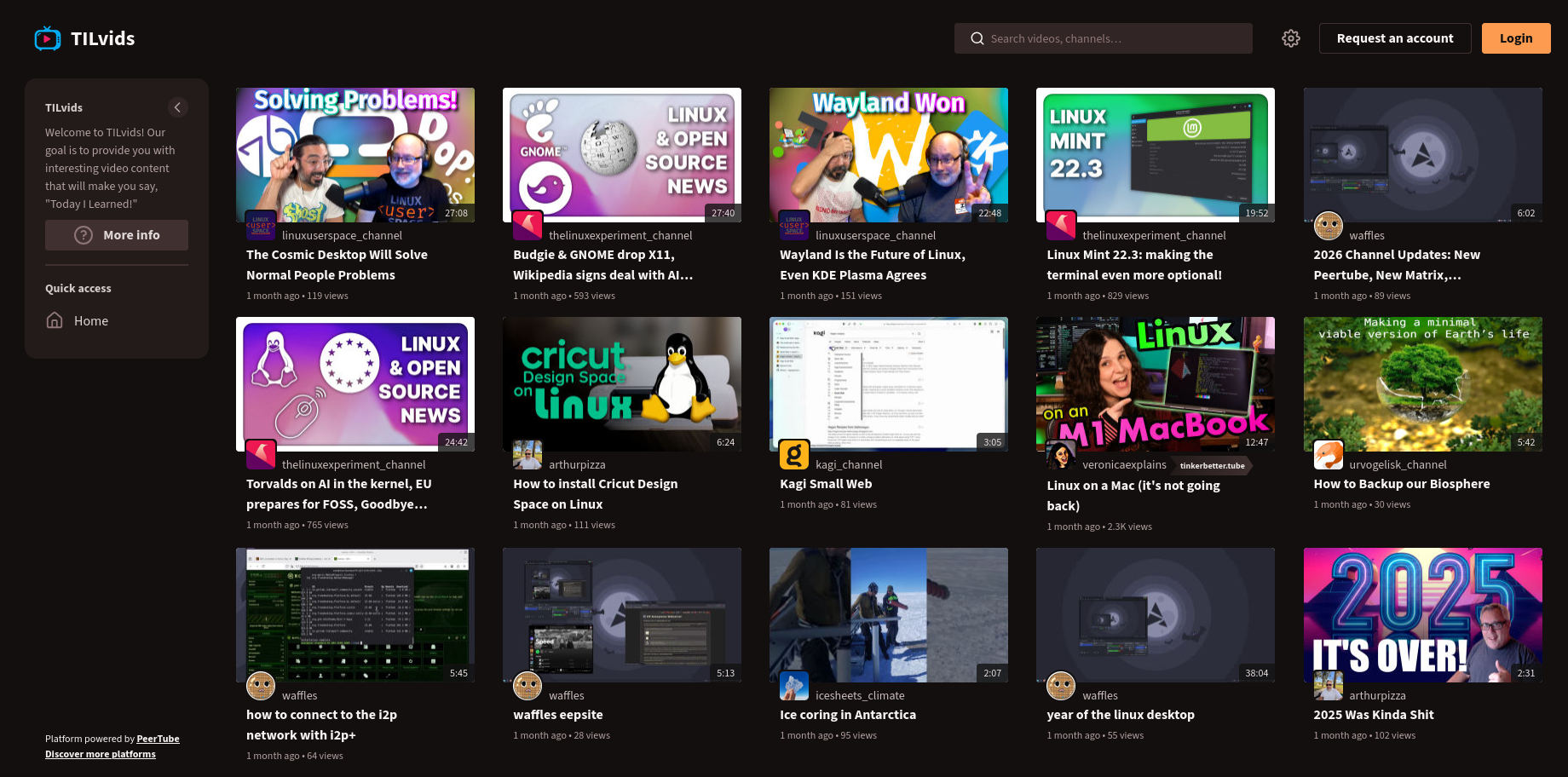
With a dedicated community of nearly 6,000 users, TilVids has made some pretty smart choices in reaching out to video creators across different popular niches, and have built a pretty thriving community around it. This has actually seen enough success that several creators are now hosting their own dedicated PeerTube servers, effectively creating affiliate networks.
In Conclusion
Advocacy for the Fediverse has to go beyond word-of-mouth, and grow past old ways of thinking about things. We need to attempt daring, bold new initiatives that focus on making the network accessible to newcomers, while finding new ways to serve communities. This requires us to think about a lot of different things, from messaging to presentation to distinct ways of solving problems.
I think the future of the network looks bright.